How to choose the right personalised storybook
- Written by
- Yoopbook Editorial Team
- Last reviewed
- 24 July 2026
- Reviewed for
- Story-selection and product-truth guidance
The short answer
Choose the story before judging the personalisation. Start with the reading moment you want to create, then compare the premise, required cast and separate-photo count. Only after that should you evaluate the artwork, physical format, current availability and order options.
Keep these four things in mind
- A strong story fit matters more than the number of custom fields.
- The required cast should match the relationship at the centre of the gift.
- Photo count follows cast; it is not an interchangeable product option.
- Age, language, page count and delivery claims should be trusted only when explicitly confirmed.
01
Begin with the reading moment
Imagine when the book will be opened. Is it meant to feel celebratory, calm, curious or reassuring? Is the intended pleasure a one-day surprise, a repeatable bedtime read or a shared adventure? That job is more useful than choosing a cover colour or chasing the largest number of personalisation fields.
A birthday story should work as a story after the wrapping paper is gone. A bedtime story should have a tone you would willingly revisit. An adventure should give the child a meaningful part in what happens, not merely place a name on the first page.
02
Read the premise as carefully as the product features
The premise should tell you what the central character wants, encounters or changes. Look for a specific authored action rather than a generic promise of “magic.” If the description could apply to every book in the store, it is not helping you choose.
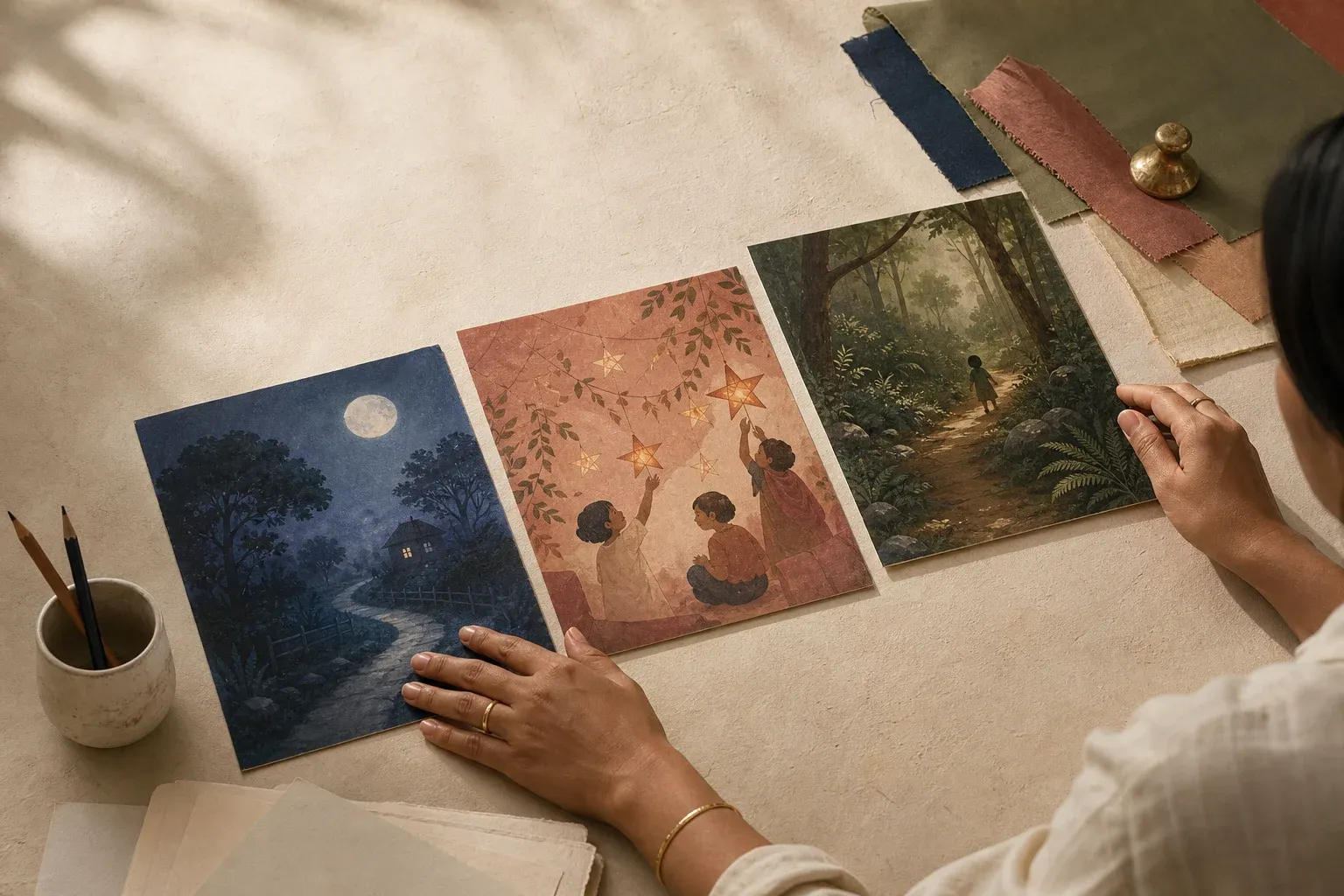
Representative interior scenes are particularly valuable when they show different story moments while keeping the same cast recognisable. They should be labelled honestly; a demonstration scene is not automatically a preview of your exact finished copy.
03
Match the cast to the relationship
Check which roles the story actually requires. A solo-child story centres the child differently from a sibling story or a parent-and-child story. The relationship should be written into the scenes rather than added as an optional face at the end.
Every required person needs a separate primary photograph. If you want two people in the book, choose an edition authored for those two roles instead of assuming any story can accept an extra character.
04
Separate verified facts from appealing possibilities
Before ordering, confirm the supported story language, physical format, current price, availability and the delivery choices shown at checkout. Treat age guidance, page count, materials or production timing as unknown unless the edition states them clearly and consistently.
More options are not automatically more premium. A smaller set of well-authored, inspectable decisions can produce a more coherent book than a long form that implies the buyer is writing the story.
- Is this exact story currently available?
- Which roles are declared?
- How many separate photographs are required?
- Which language and format can actually be selected?
- Is the imagery representative, physical-product proof or customer-specific proof?
- Which delivery options appear at checkout?
05
Compare books on evidence, not superlatives
Look for two kinds of proof: story proof and making proof. Story proof shows a specific premise, varied scenes and a coherent cast. Making proof explains how photographs are prepared, how role mapping works and what is reviewed before production.
Ratings, awards and customer numbers can be useful only when they are genuine and traceable. In their absence, clear examples and candid product information are stronger than invented social proof.
Your next step
Compare the current stories
Open each edition to check its premise, cast, photograph requirement and currently offered options.
Compare the current stories