The useful distinction is not how many form fields a service presents. It is what the buyer supplies, what the maker changes and what kind of reading or memory experience arrives.
comparison7 min read
Types of personalised children’s books compared
Compare name-only books, configurable avatars, photo books and illustrated-likeness storybooks by what changes, what remains authored and what proof a buyer should inspect.
Written byYoopbook Editorial TeamEditorial teamReviewed byNishit GuptaFounder and product fact owner
Last reviewed July 27, 2026
The short answer
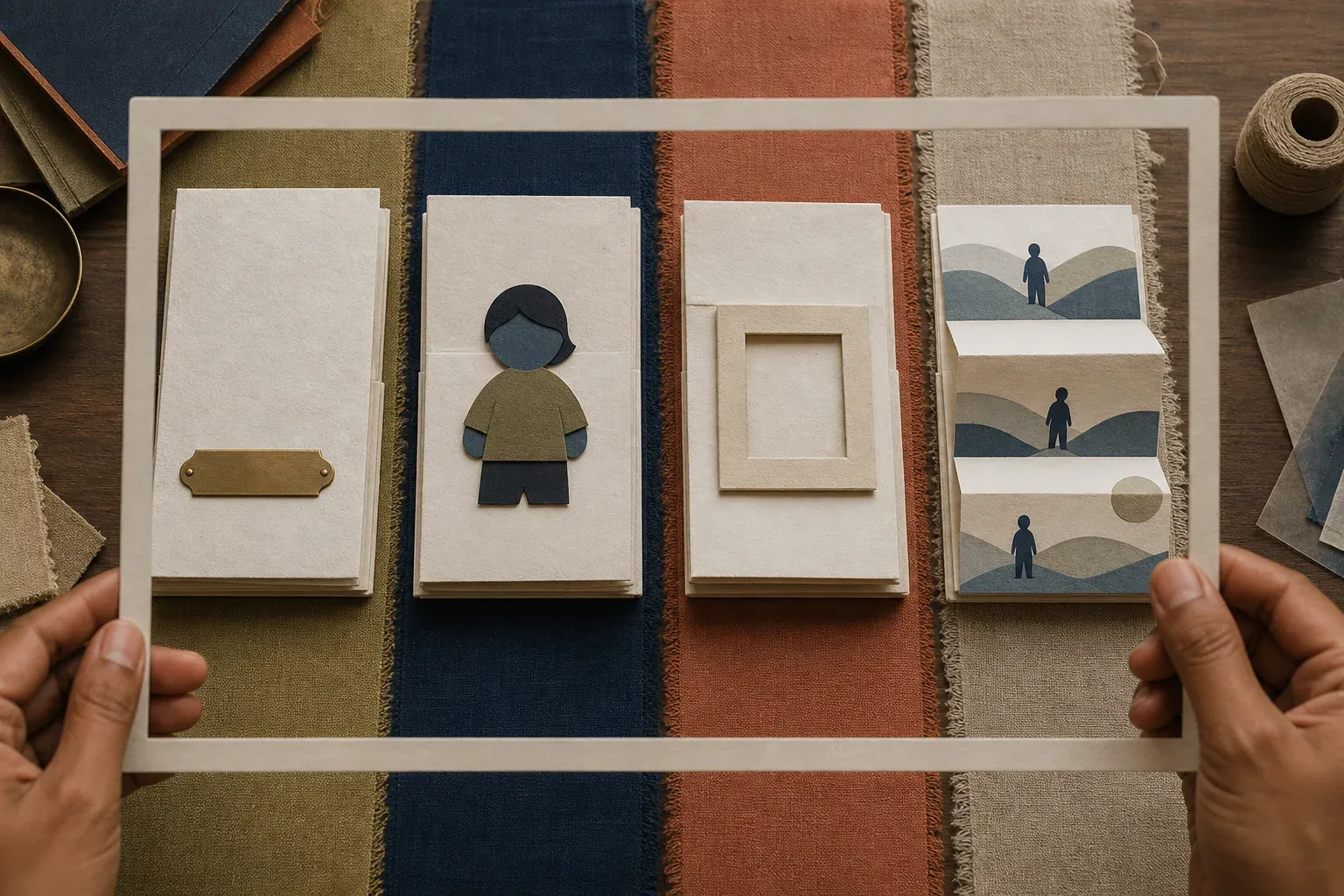
Personalised children’s books are not one product type. Some change only a name, some configure a reusable avatar, some arrange family photographs, and some illustrate a recognisable person through an authored sequence of scenes. Compare them by the reading experience, the evidence shown, the information required and whether the finished result matches the reason you are buying.
Keep these four things in view
Decision notes- 01
More custom fields do not automatically create a better story.
- 02
Photo books and authored storybooks serve different reading jobs.
- 03
Illustrated likeness should be demonstrated across varied scenes.
- 04
The buyer should know exactly what information changes the book.
On this page
Four kinds of personalisation at a glance
A buyer-focused comparison of four common personalised-book models
| Criterion | Name-only | Configurable avatar | Family photo book | Illustrated likeness |
|---|---|---|---|---|
| Buyer provides | A name and sometimes a dedication | Selected appearance options | A collection of photographs and captions | A clear identity photograph for each declared role |
| What changes | Selected text fields | Designed character features | Photographs, sequence and layout | Who inhabits the authored illustrated scenes |
| Best suited to | Simple recognition | Consistent stylised representation | Documenting real memories | Imaginative stories with recognisable people |
| Proof to inspect | Story and typography | Representation and option range | Print, layout and colour handling | Identity continuity across varied scenes |
This comparison is editorial guidance, not a substitute for checking the currently offered product and checkout facts.
Name-only personalisation
A name-only book inserts a child’s name into a fixed text and sometimes onto the cover. This can create a clear moment of recognition with very little information from the buyer.
The right evaluation question is not whether this is “less personalised.” Ask whether the fixed illustrations and story are strong enough for the intended gift. A simple mechanism can still support a good authored book.
Configurable avatar books
Avatar books ask the buyer to choose features such as hair, skin tone, clothing or accessories. The same designed character can then appear consistently because it is built from a controlled visual system.
Inspect representation, range and consistency. A long configurator can feel impressive while still producing a generic likeness. The useful test is whether the options describe the child respectfully and whether the story is worth reading.
Family photo books
A photo book arranges real photographs, captions and memories. It is often the most direct way to preserve an actual event, trip or family history because the pages show the people and places themselves.
A photo book is not automatically an authored children’s story. Choose it when documentary memory is the goal; choose a storybook when you want a designed narrative in which a recognisable character acts inside an illustrated world.
Illustrated-likeness storybooks
An illustrated-likeness book uses a person’s photograph as identity reference while the authored scenes control action, pose, expression intent, costume and environment. The difficult work is not generating one flattering portrait; it is preserving the same identity across the entire visual sequence.
Look for a clearly labelled source-photo example followed by several different scenes. The proof should vary distance, lighting, expression or action without silently becoming a different child.
Use the same six questions for every type
A fair comparison begins with the desired reading moment and ends with inspectable product facts. Avoid letting a dramatic technology claim replace evidence of the actual book.
Use the same six questions for every type: checklist
What changes in the text, cover and illustrations?
What information or photographs must the buyer provide?
Can the complete story premise be understood before ordering?
Is personalisation proof shown across more than one scene?
Are physical format, price and availability stated consistently?
Does this model fit the memory, story or relationship the gift should preserve?
Editorial record
How this page was made
- Evidence basis
- First-party analysis of four product models and the information each model asks a buyer to provide.
- Testing status
- No named competing physical product was ordered or tested for this guide.
- Commercial interest
- Yoopbook is developing the illustrated-likeness model discussed here.
- Limitation
- Individual services vary; verify the current product page, preview, privacy terms and physical specifications before ordering.
Review scope: Personalisation-model distinctions and proof requirements
Sources checked (5)
- Yoopbook editorial standards
Yoopbook · first-party-source · checked July 28, 2026
Defines Yoopbook’s sourcing, correction, review and product-truth boundaries.
- Yoopbook storefront
Yoopbook · product-truth · checked July 28, 2026
Current first-party presentation of the authored-story, cast and source-photo model.
- Create custom photo books and albums
Shutterfly · first-party-source · checked July 28, 2026
First-party example of the family photo-book model described in the comparison.
- Personalized books for kids, adults and pets
Hooray Heroes · first-party-source · checked July 28, 2026
First-party example of configurable-name and appearance personalisation.
- How You Got Your Name
Wonderbly · first-party-source · checked July 28, 2026
First-party example of name-led personalised storytelling.
Continue with confidence
Related reading
Understand how story, declared cast and separate photographs fit together before comparing the available editions.
See Yoopbook’s authored-story model